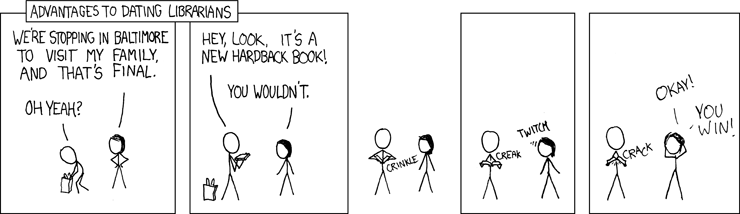
Tuesday, December 02, 2008

Popular Reading in Academic Libraries

Ah, finally some time for professional development after a crazy semester...

I'm reading a great article entitled "Giving Pleasure Its Due: Collection Promotion and Readers' Advisory in Academic Libraries" (The Journal of Academic Librarianship, 34.6: 520-526). The authors of this article make a number of suggestions for incorporating popular reading into the academic library:
  1. Create genre lists (in print and/or online) of popular reading materials held by the library.
  2. Leave the book jackets on to grab readers' attention.
  3. Displays: pick a popular reading book and highlight related nonfiction and archival materials, books from the year end "Best of..." lists, Banned Books Week, books and their movies, staff recommendations, etc.
  4. Bring eye-catching books (and CDs or DVDs) to display during instruction sessions.
  5. Recommend and encourage use of the local public library for popular reading and for various assignments where a public library would have more resources (self-help books, an entire class reading the same novel, etc). Along with that, of course, is having an awareness of the local public library's policies for college students.
  6. Become more familiar with readers' advisory resources.
I would also add that reading Publishers Weekly is a great way to keep up on the popular books. We circulate it around the staff here. While I occasionally find books to add to my library's collection, I more often find books I want to read or that I want to recommend to friends.

I have done a few things both at my current library and my previous one to promote popular reading. Over the Summer, I put together a more or less permanent popular reading display (as opposed to all the other displays I attempt to change monthly). The books cycle as they are checked out. At my previous job, I set up a popular reading collection by leasing books through McNaughton. I also really enjoy creating displays for Banned Books Week, although sadly I did not have time to do that this year. After reading this article, I am also considering the creation of a online list of popular reading books available here at my library, which will be helpful to students and also to me when I'm trying to restock the display. :)

Wednesday, October 15, 2008

It could have been me?

An adjunct librarian shot and killed a librarian at Northeast Lakeview College near San Antonio, Texas. Read the story here and here.

The crazy part?
1. I applied for a job at this college in Fall 2007.
2. I had a phone interview.
3. The interviewer said they were VERY interested in me - I fit the position perfectly.
4. My boyfriend decided to take a job in Pittsburgh instead of Texas, so I turned down the in-person interview.
5. The murdered librarian was the one who was hired for that very same job.

Yikes.

Based on the comments on a blog they set up in his memory, he was a fantastic librarian with a great passion for helping students. What a terrible tragedy and such a loss for that college, everyone who knew him, and the library community.

Friday, October 10, 2008

Book Cart Drill Team

When I went to the ALA conference way back in June, I made sure to attend the annual Book Cart Drill Team competition. Wow, that was a lot of fun. There are some videos up on YouTube that you should check out if you are interested in seeing some of the fabulous teams that competed:
  • The winners can be seen here and here. I really wish the videos were better - these guys were fantastic and hysterical. Who wouldn't win with Michael Jackson's thriller and some zombie action?!
  • 2nd place: here and here. Love the hats! They spun! And they used the fantastic librarian song.
  • 3rd place: here.
  • Also, a video from the Press Enterprise.
Makes you want to be a librarian, doesn't it? ;)

Thursday, October 09, 2008

Tuesday, September 09, 2008

Yet Another E-Reader

Plastic Logic has produced an 8.5 x 11 e-reader. Might be good for the textbook market. I know I'd prefer to carry around one of those instead of 4 huge textbooks.

Wednesday, August 27, 2008

Netflix for Online Catalogs?

We read Publisher's Weekly at work, which reviews books several months before their release. In addition to looking for books to add to my library's collection, I also keep a very lengthy list of books to read. If it's a book by a popular author, or something that has gotten a lot of press, I check to see if the public library has it in their catalog as "On Order". If they do, I put it on hold.

Inevitably, 6 books come in at once. And I don't have time to read them all. So I have to return them and reorder them. Ad nauseum.

I really wish there was a more sophisticated mechanism for limiting the number of books waiting for me at one time. Like a Netflix for books. But free through the public library and more advanced, because it would need an override option for books you want to get as soon as they come in. Like the latest book by your favorite author. Or the slew of Halloween music CDs and Halloween decoration books I just ordered from the public library (I'm sure they love me right now).

Anyone know of anything like this in the works? How about you, Innovative Interfaces? Or you, all you open source catalogs out there? I'd love to see this option, but have no idea how difficult it is to implement from a technical perspective.

Tuesday, August 05, 2008

Diversity

ALA Presentation: PR Forum: Diversity @ Your Library: Broadening Your Audience and Engaging Communities
Speakers: Eric Friedenwald-Fishman and Maria Elena Campisteguy from the Metropolitan Group

This presentation addressed the 8 Principles of Multicultural Communication, which are:

1. Leave your assumptions at the door: They recommended that you get the facts about other cultures and recognize that you often think you know what you actually do not. You can get facts by scanning news media for articles about trends, challenges, and opportunities.

2. Understand the cultural context of your audience: You need to be aware of the norms, traditions, dialects, and other cultural nuances that are unique to the audience. Be as specific as possible when defining the desired audience. It is also important to understand historical experiences and attitudes that may impact communication with that audience. Then, identify and build on the cultural strengths and assets.

3. Invest before you request: Create community-centered partnerships: This was a good point - to treat community members as partners with whom you wish to engage, not as a tool for you to use. Get them involved early on. Don't try things out on them, ask them what they want instead. And then maintain that communication.

4. Build authentic relationships: Maintain a long-term perspective: Go to the community and work with trusted allies. Don't become a one-hit wonder - keep at it.

5. Build shared ownership: Engage people, don't just involve them! Make sure there are seats at the table for members of your audience to have input.

6. Walk your talk - Lead by example: Examine your organization and be honest in your examination. Do what you say you believe others should do and deliver on your promises.

7. Relate, don't translate: This one really stuck with me. You have to do more than just translate existing ads into another language. The values you may be drawing on may not be highly valued in the culture you are translating the ad for. Make sure the ad appeals to that culture.

8. Anticipate change: Be prepared to succeed: Recognize that your process and approach to the work may change. Continue to build infrastructure to support multi-cultural success.

In addition, for more PR information, check out the PR blog Visibility @ your Library or join the discussion list prtalk@ala.org.

Cats in Libraries?

While I like the idea of cats in libraries (I like cats, I like libraries, why shouldn't they go together?), I always wonder about the wisdom of such a decision. Cat allergies are very common.

Perhaps one cat in a large library doesn't have much of an impact on allergies, but watch out for the cat's favorite chair or shelf of books. I know my cat finds it rather entertaining to climb on top of the books on one of the bottom rows of my book shelves.

For a map of libraries with cats (both alive and statue/stuffed animal), check out Iron Frog Productions' Library Cat Map.

Friday, July 11, 2008

Google Librarian Newsletter is back!

The Google Librarian Newsletter is back after a one year hiatus (you can subscribe at the bottom of that page). The corresponding Librarian Central blog, however, will not be returning.

This particular issue of the newsletter covers the following:
  • Improvements and Additions to Google Book Search: Books showing up in regular Google search results, the ability to report bad scans, and the Dynamic Links API which allows libraries to link to specific books in Google Books from records within the catalog.
  • Google Sky: Now available through your browser, in addition to it's inclusion in the downloadable Google Earth.
  • Google Health: Allows patients to store, manage, and share their health information with medical providers. This would have been quite useful in determining what shots I have and have not received that are important for my upcoming trip to China.
There is also a Google for Educators resource center that might be worth checking out.

Also, I leave tomorrow for China and will not be returning until July 24th. I know my blog posting is sparse anyway, but don't expect to be reading any new posts for a while. :)

Wednesday, July 09, 2008

No Clear Standard for Liaison Duties

ALA Presentation: The Plowman and the Rancher Should be Friends: A Comparison and Discussion of Liaison Duties in Public and Academic Libraries
Speakers: Elisabeth Leonard, Peter Larsen, Ridie Wilson Ghezzi, Donna M. Colamatteo, Bruce Reid (moderator)

I attended my first ALA conference and am going to attempt to blog at least some of it. This was the first session I attended (well, after Greg Mortenson's presentation but that's slightly less job-related).

The speakers surveyed both public and academic libraries to determine if there is a standard for what liaison librarian duties should include. They discovered that there is no clear standard. However, some common liaison responsibilities include:
  • Attending panels, conferences, meetings, etc., in that liaison area
  • 79% of respondents provide subject-specific library instruction
Dartmouth College's effort to increase/improve their liaison program was mentioned. They provided a liaison training workshop in the summer for librarians. An outside person was brought in to conduct the training. They discussed:
  • What all the liaisons were currently doing
  • What challenges and strategies existed
  • How to establish trust as a new liaison
  • How liaison activities are perceived by the faculty
  • How do liaison librarians feel about their duties
They also conducted focus groups with faculty through which they found there is no single right way for liaison librarians to do their work. However, faculty overall were very interested in assistance from liaison librarians. Faculty opinions on liaison work were deemed invaluable.

Friday, June 20, 2008

Faculty are short on time

I recently finished reading Faculty-Librarian Relationships by Paul O. Jenkins. The number one thing I took away from this book is that faculty are extremely busy people who cite lack of time as their number one stressor. They are expected to teach, research, publish, hold office hours, serve on committees, advise, and so much more - to the point where the whole idea of summers off really isn't the case. Their summers are full of all the work they had no time to do during the year. What does this mean for librarians? Anything we can do to make the lives of the faculty easier will make us look really good!

I hear (and admittedly am sometimes part of) the common complaint that it is hard to get faculty to make time for instruction in their classes. Often they probably just don't have time - to plan it, to fit it in, etc. Reaching out to them, and offering to provide however short or long an instruction session may prove more effective. I have often thought about offering to go into the classroom for 5-10 minutes, give a short intro to the library, and hand out a sheet containing a list of things librarians can help students with. But I worry that it's a slippery slope, and offering this option will result in an increase in short sessions and a decrease in 50 minute instruction sessions. I am still undecided.

Some other takeaways:
1. Often unreasonable requests come from faculty because they simply do not know library policies and procedures.
2. Let them know what we can do for them - they often don't know!

Jenkins interviewed 15 faculty members at the College of Mount Saint Joseph. Some things they mentioned:
1. One faculty member tries to tell students that librarians get excited about helping them.
2. A Ph.D. means you know a great deal about a very small area of study. People often think faculty know everything.
3. Several mentioned that students are less interested in learning and seem to be focused on doing the minimum to get the degree and the job.
4. Several also mentioned that students will not read.

The book also mentioned this great list of 100 Ways to Reach your Faculty by Terri L. Holtze. Lots of good ideas - a few of which I already do, and many which I hope to implement.

Tuesday, June 17, 2008

Unusual Bookmarks

An article from AbeBooks has some great examples of things that have been found in books, including:
  • Forty $1,000 bills
  • Piece of bacon
  • Credit cards
  • Valuable baseball cards
  • A diamond ring
Moral of the story: Be careful what you use as a bookmark. And if you find yourself the lucky recipient of a bunch of old books, it may be worth your while to go through them before donating them.

TMI

There is just too much information out there, and with the Internet, the amount of information continues to grow exponentially. An article in the New York Times discusses the problem of information overload and what tech companies plan to do about it.

Google, Intel, Microsoft, and IBM have gotten together and formed the Information Overload Research Group, which aims to study this problem, publish information, and find ways to solve it. Their focus is primarily around workers who are easily distracted by incoming emails. I must confess, I'm definitely one of them - Outlook's feature displaying snippets of each incoming email in the bottom corner of the screen is just so distracting, yet I can't make myself turn it off!

Some possible solutions, or at least steps in the right direction:
1. Check email less often
2. Send emails more frugally (I wish some of the listservs I am on would practice this)
3. Be sure to reply to only those who need to hear your response.

And some interesting statistics:
1. "A typical information worker who sits at a computer all day turns to his e-mail program more than 50 times and uses instant messaging 77 times" (really? only 50 times?)
2. "In the United States, more than $650 billion a year in productivity is lost because of unnecessary interruptions"

Friday, June 06, 2008

Machine for Lending Books

An interesting article in the Contra Costa Times describes a new machine situated at a BART train station in California. The machine contains approximately 400 paperback library books - both fiction and non-fiction. Commuters can use their library cards to check out books to read on their train rides. The books are due back in 3 weeks.

What a neat idea for bringing books to the patrons!

Sunday, June 01, 2008

New Blog

I have started a new blog. After a great deal of debate, I have reached the conclusion that Adventures in Library Land needs to be devoted solely to library-related information. Thus, I created Growing Green Cents, which will include information on personal finance, the Green movement, and growing plants.

I have also decided to change my post name from Kat to Kate. I was only very temporarily called Kat (at about the time I started this blog), and it did not stick. So Kate it is.

While I am uncertain about the wisdom of maintaining 2 and 1/5 blogs, I am interested in seeing how it goes. Wish me luck! :)

Friday, May 16, 2008

Open J-Gate

Also recently mentioned on a listserv is Open J-Gate, which bills itself as the "World's biggest Open Access English Language Journals Portal" and includes 4386 journals. I feel like I must have known about this at one time, but there is just so much information out there that I cannot keep track of it all. I am more familiar with the Directory of Open Access Journals, which contains 3365 journals.

For any of you out there not affiliated with an academic institution, these are both great resources when doing research.

Why Libraries Pay More for Journals

Just why exactly do libraries have to pay institutional prices for journals, which are often many times the prices of individual subscriptions? Why can't we just have professors/patrons who are already getting individual subscriptions donate them to us when they are finished?

There's been an interesting discussing on COLLIB about these very questions, and I have to confess that while I knew that this is what we did - pay institutional prices - I never knew exactly why. One of the posters on the listserv pointed out this great article about the reasons behind the institutional fees. Apparently journal publishers are using differential pricing to make up their necessary costs. That is, they cannot make enough money to sustain their business off individual subscription fees, so they make up the difference by also including institutional fees. So why don't libraries just try to pay the individual price? It would be considered fraud.

As to the question about professors/patrons donating journals, the article states that this is an acceptable practice. However, it's far less reliable - a professor make not have time to read each issue during busy semesters and may hold on to them for a while, issues may get lost before they can be donated to the library leaving the library with no recourse to obtain the issue, and so on.

So, good to know, but I'm still not sure the 10-15% increase we commonly see in journal subscription prices each year is necessary. And the higher the prices go, the more libraries will have to cut back on their subscriptions.. which will cause the prices to continue to skyrocket in a never-ending cycle. I know my library will be looking very seriously at its journal holdings this summer and making some significant cuts.

Monday, May 12, 2008

Keep your Faculty Up-To-Date!

Show Your Faculty Some Love #4: Keep them Up-To-Date

One of the difficult things to accomplish is keeping faculty up-to-date on all the resources and services the library has to offer. We send email notices, but when sent en masse, do they read them? We send around newsletters, but do those get read? How do we make the information relevant to each person, easily digestible, and quickly imparted?

At my previous institution, Andrew and I presented at the Fall Faculty Conferences two years in a row (and hopefully this will continue to be a yearly opportunity there). These sessions were less than an hour in length. They were part of a conference at the college that faculty were already required to attend. There were several sessions that ran concurrently, and the library's update session was one of those. And it worked. We quickly covered all the changes that had taken place in the library, mentioned some extremely useful services that do not get much use, tried to point out which disciplines (and therefore which faculty) would most benefit from new resources and services, and more. It was quick, it was part of a pre-existing requirement for the faculty, it was relevant, and, I hope, it was entertaining.

Will I have the opportunity to do this at my current institution? Perhaps not. Which means I will just have to continue to find more ways to reach the faculty here.

___________
To read other articles in the Show Your Faculty Some Love series, click here.

Thursday, May 08, 2008

We all love free stuff

Show Your Faculty Some Love #4: Free Stuff!

Let's face it, everyone loves free stuff. Even when they have no idea what they are going to do with it. At my previous institution, we had pens made with the Library's information on them. We sent the pens, along with OhioLINK sticky notes and a short memo, to all faculty. It was appreciated. We also gave them out to all the first year students, and to the students in many of our one-shot instruction sessions. We got at least one comment about the pens being everywhere on campus.

We also had mugs which we gave to new faculty. They seemed to like them, although I recall that they had received other free stuff the same day (it was during their orientation), so it was less exciting.

But free stuff. Always a good thing. We are hopefully going to get pens made at my current Library this summer to give out in the Fall.


___________
To read other articles in the Show Your Faculty Some Love series, click here.

Tuesday, March 25, 2008

I am YOUR Librarian

Show Your Faculty Some Love #3: I am YOUR Librarian

It's interesting what sticks with people. I made of point of telling the faculty in my liaison areas that I am their librarian. This is not my original idea. I read it somewhere, and I'd give credit, but I've long since forgotten where I read it.

These faculty now repeat this to newcomers - "She is our librarian." Perhaps they find it humorous, perhaps they really like the idea, the reason doesn't matter. The important part is they remember it, they repeat it, and they appear to believe it.

Works for me. :)

___________
To read other articles in the Show Your Faculty Some Love series, click here.

Thursday, March 13, 2008

Way Sweet

To use lingo picked up from a library school friend, this is definitely "way sweet". The CONSORT Libraries (Denison University, Kenyon College, Ohio Wesleyan University, and the College of Wooster) catalog has the option to send yourself the location information of an item via a text message. For an example, see here. Click on the "?" for the disclaimer (i.e., based on your cell phone plan, you may get billed for the text message).

Don't want to write it down? Have it sent to your phone!

Is it a new feature from the catalog providers? Is it a hack? I don't know, but it sure is way sweet.

Wednesday, March 12, 2008

News in 100 words or less

About a week ago, someone sent an email about Brijit to a listserv I am on.

What Brijit does: Every time a new article is published in certain magazines or newspapers, it's offered up for summarization. The number of summarizers is fixed - to about 3. These summarizers then read the article and write a long description of the article that is 100 words or less. Only one summary is chosen for inclusion on Brijit. The writer of the chosen summary receives $5.

So basically, you can pop over to Brijit and get the news in a lot less time. No longer do you have to read lengthy articles. Brijit provides the short summaries for you.

An interesting concept. Read more about it in this National Post article.

Monday, March 03, 2008

Friday, February 22, 2008

MeeboMe and Facebook

A coworker and I recently set up a fan page for our library in Facebook, MeeboMe, and Pidgin.

The fan page was a lot of fun to create, as well as quick and easy. We suggested to a number of student workers that they become fans. We are currently up to 11 fans. Our fan page includes a MeeboMe widget, as well as the usual discussion board, pictures, notes, events, general info, etc. I may have to peruse the list of apps to see if any others would be good additions. Also great about the Facebook fan page is that you can see statistics. People may become fans and never look at the page again. Stats allow us to see how often people actually visit.

We also put a MeeboMe widget on our subject guides (hooray for pbwiki's sidebar! I did not want to have to install it on each page. Plus, if you edit the page, it changes the widget code for some unknown reason. This makes the widget stop working until I re-paste in the correct code. Not sure why it does that, but it's quite annoying). We also intend to find out if it's possible to put the widget on our library page within the campus portal.

Trillian, our current IM client, only allows us to add AIM, ICQ, MSN, and Yahoo accounts in the free version (how silly). So we switched to Pidgin. Chad Boeninger at Library Voice has an excellent explanation of how to set up MeeboMe and Pidgin. We also added a Google Talk account just to cover all our bases. Not that students don't all just use AIM anyway.

Friday, February 08, 2008

Public Library Resources

It always amazes me when I check out public library websites and discover all the great resources they have to offer. Ohio and PA have fantastic public library networks that group purchase databases to give everyone in the state with a library card access to those databases (well, perhaps. I think some states give everyone access but others require individual libraries to pay to be a member and have access).

So if you want to check them out, here's how to do it:

Ohio: Visit the OPLIN (Ohio Public Library Information Network) website, click on Research Databases on the left hand side (or just click here), and pick a resource. You will be prompted to enter your library card number or zip code. I think it recognizes most Ohio computers and just prompts for zip code, so technically you probably don't even need a library card.

PA: Not quite as easy. You need to go through the website of whichever public library you use. The library network is called POWER Library. However, many of the public libraries probably provide additional databases as well (well, Carnegie Library of Pittsburgh does, at least).

Everyone Else: Check out the website of your local library. Look for a link to "Research Databases", "Resources", etc. Then find out what your library offers.

What kind of things are often included?
  • Resources for kids to use for research
  • Car repair databases
  • Financial databases (Standard & Poors, Morningstar, etc)
  • EBSCO databases - Academic Search Premier, Health Source, Business Search Premier, EBSCO Animals, and much more
  • Resources to help you find popular reading materials (NoveList)
  • Online encyclopedias
  • Lots lots lots more.

Thursday, February 07, 2008

The Google Generation

I am finally getting around to reading the CIBER briefing paper entitled "Information behaviour of the researcher of the future" (Jan 11, 2008). It discusses the "Google Generation," which it defines as including those born after 1993.

It contains some interesting information:
Users assess authority and trust for themselves in a matter of seconds by dipping and cross-checking across different sites and by relying on favoured brands (e.g. Google). (p.10)
Some of the information is completely unsurprising (i.e. I see it in college students all the time):
young people have a poor understanding of their information needs and thus find it difficult to develop effective search strategies. (p.12)
faced with a long list of search hits, young people find it difficult to assess the relevance of the materials presented and often print off pages with no more than a perfunctory glance at them. (p.12)
Which often leaves them in trouble when they go to write the paper the night before and find they have a bunch of unrelated articles that they need to use to write a coherent paper.

The study also examined a number of characteristics commonly associated with the Google generation. For example, "They have zero tolerance for delay and their information needs must be fulfilled immediately" (p.19). This particular example was found by the report to lack hard evidence in support of it. Interesting, because I would have thought this was particularly true. However, the idea that they are a "cut and paste" generation with lots of plagiarism seems generally true. Also, the idea that the Google Generation consists of "expert searchers" was examined. Ciber's conclusion:
This is a dangerous myth. Digital literacies and information literacies do not go hand in hand. A careful look at the literature over the past 25 years finds no improvement (or deterioration) in young people's information skills. (p. 20)
Also interesting is the idea that students really need to have "exposure to basic library skills" earlier in life - from parents, school libraries, public library, or classroom. I'm not sure what all is included in these basic library skills, but I think even the most basic exposure (being in a library, talking with a friendly librarian, etc) increases future library use. For some reason, libraries are often viewed as intimidating places (and those librarians, they are scary as can be!), and early exposure would reduce this library anxiety (unless of course they encountered a crotchety shushing librarian). This then makes for college students who would perhaps be far more receptive to the library and use of the library, and more open to learning advanced library skills.

Of course, another reason (and the one mentioned by this report) for early exposure to basic library skills is to prevent the development of poor skills which would be hard to overcome. The whole "I'll just find everything through Google because everything there seems pretty reliable" mentality.

Some interesting implications and some big hurdles. It seems to me that it's getting less and less likely that younger children will get basic library skills exposure. This is particularly true with the school library, since they keep firing all of those librarians.

Tuesday, February 05, 2008

Lots of Instruction

I always forget how crazy the weather gets in winter in my neck of the woods. I have always lived in the same general vicinity (give or take 150 miles), and still I forget every winter. Today it is 60 and absolutely pouring. Thursday they are calling for snow. Gotta love it.

I have been pretty busy lately with instruction. I had 7 sessions in 2 weeks. While that may not seem like a huge amount, it is when considering it's all the sessions I had lined up (last one is today). They just all came at once, and with it being a new job and needing to prove to a new set of professors that I can help their students, it's been a little stressful. Additionally, I am now responsible for business-related instruction, which is pretty new to me, so I have had to do a lot of research for a few of the sessions.

But I do love teaching. And I love working one on one with the students. I actually visited one class twice. The first time was for a standard instruction session, the second time was just to answer questions while the students were searching the databases. I think it's great that this professor wants his students to become so familiar with the databases that he schedules several days of class time to do it. The class is a research class, actually, so it makes sense.

I also really liked that he made sure to emphasize both times that one of the major reasons I came to the class was so everyone would get to know me and could feel comfortable coming to me with questions in the future. To me, that's a very important component, so it's great when profs think so too.

While I have probably written about it before, I cannot emphasize enough how important it is to give students time to do some searching on their own during the session. They need time to apply what they learn and also to assimilate new information into their already existing knowledge base. In most cases, I prefer to have them search first so I can see what they already know and what techniques will be most useful to point out. However, with a recent class, I went over everything first because there were two specific limiters that gave them exactly the type of articles they needed. It seemed silly to make them struggle on their own before showing them the two things they really needed to know.

Tuesday, January 29, 2008

I have no shame. But my savings account has higher interest!

Okay, I'm going to write an absolutely shameless post. My apologies.

I recently signed up for an Orange Savings Account through ING Direct. Currently, the interest rate is 3.65% APY. It was 4.10% but then the market plummeted. It's not a guaranteed amount and they can change it when they want but it seems to stay pretty high.

This is far better than most banks. My current bank gives 1.00% interest per year, and I think that's better than most.

It's also very easy to sign up (although it does take more than the 5 minutes they claim because I can't read all their privacy policy and terms and conditions stuff in 5 minutes). They link your Orange Savings Account to your current checking account at whatever bank you use. As long as you go through ING to request transfers of money to or from, there are no fees. It takes approx 2-3 days for a transfer to go through because of the method they use. There is also an initial period where you can't take any money out of the Orange Savings Account when you first sign up - I think it's 10 days?

They are also known for great customer service. I called to ask a question, and I got a real (and very helpful) person without going through a menu. How awesome is that?

So basically, it's a way to have a higher interest rate on a regular old savings account. I also like that it's an online bank (FDIC insured, no worries), so if I move it doesn't matter. They're still just as accessible.

So here comes the shameless part:
I have a number of referrals to give out (not sure the exact amount - 10 to 20?). If you sign up within a month of receiving a referral and put in at least a $250 initial deposit, you will get an extra $25 sign-on bonus. I will get $10 for every referral.

I did not have a referral when I signed up for ING and I wish I had. So if anyone is interested, shoot me an email.

Thursday, January 17, 2008

Institutional Repositories

A rather nebulous term, I suppose, but a truly fantastic idea. An institutional repository gives professors and researchers a place to post their articles where anyone can access them for free.

California has created a version of this called the eScholarship Repository, which "provides a robust full-spectrum, open access publishing platform for pre-prints, post-prints, peer-reviewed articles, edited volumes and peer-reviewed journals" (quote taken from this UC article). Not only is this open to those in California, but to the rest of us as well. It is also structured in such a way as to be searchable by Google so I have added it to my Free Full-text E-Journals custom search engine (see the right-hand side of this blog for the search box. For more information about this custom search engine, see my previous post).

It is unfortunate in the academic publishing world that professors (and other researchers) very often give up their rights to their own work when publishing in a journal. Once accepted by a journal, that work becomes the property of the journal, not the professor. Many professors do not even think about this loss of rights because they need to publish for tenure purposes. Part of creating awareness of an institutional repository would necessarily include discussion about maintaining one's rights to a work, which is a good thing. The more professors are aware that they need to keep their rights, the more articles can be put in institutional repositories!

Tuesday, January 15, 2008

Thursday, January 10, 2008

Librarian Wins Award

Sometimes you read something, and you just don't know what to say. I have no words to express my reaction to this.

[Link found on The Laughing Librarian]

Tasty Reads 3: Made to Stick

Title: Made to Stick: Why Some Ideas Survive and Others Die
Authors: Chip Heath & Dan Health

"Any of us, with the right insight and the right message, can make an idea stick." (p.252)

This is a great marketing book all about how to create ideas that people will remember. The authors outline the six key ingredients of a sticky idea, explaining each with a few stories that help it stick in the minds of their readers. To be extremely sticky, an idea needs to be:

1. Simple - Find the core of the idea, the single most important point you are trying to communicate. Your audience can only remember so many things.

2. Unexpected - Surprise them to get their attention, then keep their attention by creating interest. Create a mystery. An example from Made to Stick tells of a book that started off with this story: For years, scientists at well-known institutions debated about what Saturn's rings were made of - dust (MIT), gas (Cambridge), or ice crystals (Cal Tech). Then, the story unfolded, until, much later in the book, the answer was given: ice-covered dust. Needless to say, the reader was enthralled as to how such renowned universities could have scientists who couldn't solve this problem. It's unexpected.

3. Concrete - It's far easier to remember concrete images and specifics than it is to remember an abstraction.

4. Credible - Be or use a credible source - e.g., people with personal experience. (Jared lost all that weight from eating Subway. He's credible - he personally experienced the weight loss). I can see this working in libraries: Provide a concrete example/quote/etc from a student whose research was made much easier by using a library database or by consulting a librarian.

5. Emotion - Make people care about the idea. Invoke self-interest. How will it affect them? What will it do for them?

6. Exemplified through stories - Stories are entertaining. Include them when you can. They make the idea more life-like. They can also provide inspiration which drives action.

You also have to be careful to avoid the Curse of Knowledge. Ideas that may seem simple to me, aren't to others. For example, to me, it's completely obvious that you should use a library database to search for articles. However, others are going, "What's a database? What if I want books?"

All in all, a great read for those with interest in marketing.

Free Credit Report

I have a friend who regularly pulls her credit report to make sure nothing has gone awry. I thought it wouldn't be a bad thing to do, but didn't want to spend any money doing it. I have pretty good credit so I wasn't too worried.

Yesterday, I read about annualcreditreport.com at beingfrugal.net. This site lets you obtain your credit report for free once a year from 3 different reporting agencies: Equifax, Experian and TransUnion. According to the FAQ, you can space out your requests. Yesterday, I got mine from Equifax. Disappointingly, it did not have my credit score (which apparently is never free to obtain), but the rest of the information was useful. At 17 pages long, there's a lot of stuff there - student loans, credit cards, closed accounts, soft and hard inquiries on your credit, negatives (I don't have any - woo hoo!), etc. It also reminds you that it's a good idea to keep your oldest line of credit open. Don't close that first credit card or bank account if you can help it.

While opening a new credit card account has an effect on your account, checking your own credit does not. There are soft inquiries and hard inquiries, and this is a soft one (see here for more info).

Going along with the credit thing, I called 1-888-5-OPT-OUT yesterday so that I would stop getting offers from credit card and insurance companies in the mail. It is super easy and completely automated. It does ask for your SSN, and I hate to give that out, but I have read about enough people taking advantage of this that I'm not too worried.

Wednesday, January 02, 2008

Free Science TV

While perusing ONLINE, which bills itself as "The Leading Magazine for Information Professionals" (who knew?), I discovered SciVee. The National Science Foundation and the San Diego Supercomputer Center teamed up with the Public Library of Science to create SciVee, which contains video presentations by scientists describing the work they have done for their scientific papers, and more recently, work not related to scientific papers as well.

Basically it's a YouTube for science. Bet it has some interesting stuff!

Thursday, December 27, 2007

New Year's Resolutions

Goal 1: I mentioned in a previous post that one of my New Year's Resolutions is to pay off my car much more quickly than the current payment schedule calls for. To quantify this goal, I found a calculator that allows you to plug in different additional monthly payment amounts. It then tells you how much money you'll save in interest and how many fewer months it will take. The one drawback is that I recently sent in a large-ish check to reduce the principal, so I had to do some rough calculations to factor that in.

Using the calculator, I aim to pay my car off in 18 months (current schedule calls for approx 28), and save myself approximately $141 in interest.

Goal 2: To learn more about personal finance and investing. This one is a bit harder to quantify. However, quantify I will. To meet this goal, I will read at least 2 finance books this year (fivecentnickel has some suggestions here and here) and keep up with the personal finance blogs I subscribe to (see the Finance section).

What are your New Year's Resolutions?

Wednesday, December 26, 2007

Sexier than a librarian? Ha!

Saw this ad (or one very similar) for Sony's E-Reader in DC. Certainly not sexier than this librarian.

Friday, December 21, 2007

Personal Finance

I am on a huge personal finance kick. I've subscribed to a number of blogs. I'll probably keep subscribing to more and slowly ween them down to the ones that are most applicable to me.

They always say it's never too soon to start working on your personal finance. I am lucky to work at jobs with pretty great retirement packages, so I already have that. However, there is certainly far more that I can do to manage and improve my personal finances.

Some great advice I've discovered includes the following:

1. Get a credit card that pays. I absolutely adore my Discover Card. I have never carried a balance on it, never paid them a cent of interest, and I have made tons of money, which I redeem most commonly in the form of Borders gift cards. More recently it has occurred to me that I should be using some of the other gift cards as gifts. What a great way to save money and still give a good gift. Apparently my other credit card has a version that pays as well. I might have to see what I can do to upgrade to that.

2. Find the discounts and use coupons! There are some great websites that I'm only just learning about: RetailMeNot has all sorts of great online shopping coupon codes and user submitted success rates. Ebates is another one I've seen but haven't really looked into yet.

3. Here's a post about 25 Ways to Save Money. I'd just like to point out number 17, thank you. Using the library saves you money!

My early New Year's goal is to pay off the money I still owe on my car far more quickly than the current schedule. One thing about goals is that you should probably quantify them. I will have to look at how much I still owe and determine an appropriate, reasonable monthly amount to pay.

Wednesday, December 19, 2007

Librarians at Work

A great video (approx 2 mins) to show you just what exactly it is that we librarians do all day.

Thursday, December 13, 2007

Yet More Copyright Control

Attributor is a new company that scans the web for a publisher's content. For example, it can track how many times and where people have put up content from Harry Potter and the Deathly Hallows.

While Attributor seems interested in helping publishers with marketing and sales (if someone is posting book content somewhere, it's possible that the people who are reading it may want to buy the book, especially if only part of it is posted). However, publishers seized on the idea of using the application for copyright compliance reasons. Big surprise there.

According to the article in Publishers Weekly, tests have been done to track unauthorized copying of recipes and song lyrics as well.

Tuesday, December 04, 2007

Now that's Branding

While glancing through our newly added books, I came across two whose covers amuse me. Apparently, The Ohio State University has to decided to make it exceptionally clear which books they have published.

Check out the cover of Middle Passages and the Healing Place of History


or Victorian Sensations: Essays on a Scandalous Genre


Gotta love the upper lefthand corner (and also the top of the spine and upper right hand corner on the back - it wraps around). It's not uncommon for the publisher to be on the cover, this is just a very eye-catching version.

Monday, November 26, 2007

It's not easy being green

This isn't really a library related post (although I can try to tie it in), but lately I've become more and more interested in being as "green" as I can be. I keep checking out books or putting ones on hold that deal with being environmentally friendly. Some of the advice is too much effort, not applicable, or just silly (take your own towel to the gym and a huge amount of water will be saved? Why? It's not as if we won't wash the towel when we take it home), but there are some great ideas out there:
  • Use canvas bags. Finally! A use for all those dang bags they give out at library conferences (I have at least 4!). Take them to the grocery store, use them when you pick up your library books (see, I can tie it in to the library), and more.
  • Reuse gift bags, ribbon, and even wrapping paper. I've always done this, but now I can claim it's because I'm "green" instead of cheap. :)
  • Buy LED Xmas Lights. They are expensive but LEDs last forever. I've been told that it is likely that the wiring will go bad long before the LEDs die. Plus, they are pretty cool looking. I haven't yet bought these, but am planning to.
I subscribe to two green blogs that are pretty good:

Little Known Librarian Duties

I am a librarian. Most of you think of librarians as book, and perhaps video and CD, dispensers, but I also dispense many other things:
  • Highlighters
  • Scotch Tape
  • Post-it Notes
  • Paper Clips
  • Pens
  • Pencils
  • White-out
  • Glue
  • Scissors
  • Change for $1.00 for laundry
I don't know why I find it so amusing that students ask me for these things. Perhaps because when one shows up at the library with a huge poster board, you'd think that person would also bring stuff with which to stick things onto said poster board. And other items with which to cut out pictures for the poster board. Etc.

But I loan these things out. I have yet to have something not returned (well, minus the items that would naturally not be returned). If, some day, we become known as the cheap way to get as many paper clips as you could possibly need, then I might re-evaluate. But for now, I'll dispense away.

Wednesday, November 14, 2007

Personalize it!

Show Your Faculty Some Love #2: Individualize and personalize, part 2.

I simply cannot emphasize the whole personalization thing enough. Today I attended the beginning of a meeting in one of the departments to which I am a liaison. I created a handout specific to their discipline detailing library resources for that discipline, and library services available to faculty. I put each of their names on the cover sheet. [This is something we did at my previous institution, so I should give credit to Andrew.]

The first one I handed out was met with "Wow. A woman after my own heart. Personalized!" (okay, I might be slightly off on the exact quote but that was close). I also received several other comments, including that I am very organized.

A little personalization goes a very long way. It can be surprising just how well-received these efforts are.

Also, as a note, I made guides for all the adjuncts. They weren't at the meeting, but I left them in their boxes and will send emails soon. Adjuncts often get missed, so they are great candidates for guides to library resources.

Monday, November 12, 2007

Library + Hotel = Good idea?

I am not sure what to think about this, other than, why not? The NYT ran an article detailing plans of the Donnell branch of the New York Public Library to sell their current space to a hotel company for oodles of money - with the stipulation that the library gets the first floor and two floors below ground.

They need money, their branch needs remodeled desperately, why not take the $59 million? Plus, being in a hotel might increase traffic, although I wonder what sorts of issues will come up with regards to travelers wanting to borrow books. Of course, "The two operations will have separate entrances and be divided by a wall."

Friday, November 02, 2007

It's all about Individualization

Show Your Faculty Some Love #1: Individualize and personalize.

I'm a bit peeved at myself, because I lost my list of ideas for blog posts in the "Show Your Faculty Some Love" series at some point in my recent move (it must be around here somewhere, honestly!). Oh well, I remember most of it.

Today's tip for connecting with faculty deals with the importance of individualization. I can't emphasize this one enough. Just a little extra effort goes a very long way.

For example, I recently sent emails to the faculty members in the areas for which I am the library liaison. Instead of composing one email and sending it to a distribution list, I wrote the email and sent it to each faculty member individually. I personalized each email by using their name in the greeting, and changing the department in the subject of the email, and the body. "I am the new library liaison to ....". It definitely took more time, but it was worth it. Of the approximately 38 emails I sent out, I received responses to about 11. Which is pretty good. The emails didn't need responses, they were simply introductory. I even received a list of books recommendations already from a professor from whom other library staff say they never hear.

Not bad. And it's only the beginning. More tips to come soon! :)

Thursday, October 25, 2007

Work Out Video for Librarians

I have had a blog post about this video saved in my reader for, well, a very long time. I finally watched it, and I recommend you do too. It's under 5 minutes in length and quite amusing.

And, of course, it's on YouTube.

I also need to work at Yale

Because there they have crazy drunken revelries complete with kettle corn, chants of "We love books!", streakers, and a midnight countdown for the opening of a new library. With over 1,000 students in attendance. And "several elbows were thrown as students tried to angle for best position in line to enter the library"!

Additionally, "Students around campus threw parties to celebrate the opening, including one in Swing Space that was publicized on an e-mail panlist."

A most excellent quote:
Said one visibly intoxicated girl as she arrived on Cross Campus, “I wish that our children were here to tell them that we were here, drunk as no other when the library opened. It’s too bad there’s no books, but we feel great.”
Talk about supporting your library.

I need to live in Australia

Because then I could watch The Librarians, a TV series (6 episodes) devoted to librarians and crazy library patrons. Of course, they are playing up the stereotype, but I bet it's funny! Read more about it here.

Update: Thank you to TB-) who has informed me that I can watch the episodes at ABC Australia's site for the show. Yay! I will have to do that soon!

Friday, October 19, 2007

Espresso Book Machine

Wow, this is pretty freaking cool! A NYT article discusses a machine that will print you out a book in less than 15 minutes. I really like that it's a way for people to get access to "those books that are out of print or for which there is so little demand that it would be too costly to print a few hundred copies, let alone one."

Wednesday, October 17, 2007

Library Arcade

Carnegie Mellon has created two games for research - one deals more with research questions, the other with organizing books by call number. I played the research game - not bad! Definitely worth a look! Read about the games here.

Fairfield Beach

I like this idea: using a movie to teach students some basics about the library. I also like that Fairfield Beach is a choose your own adventure type thing. Librarians wrote the script and had a student cast and film it.

I only wish I could see more of it. Watch a clip of Fairfield Beach on YouTube.

Tuesday, October 16, 2007

Political Wiki

Finally, just what I've been looking for: the Political Base wiki. Its aim is to collect all sorts of unbiased political information which anyone can add to. However, unlike Wikipedia, all submitted information must first go through a staff editor.

I've only taken a brief look so far, but I really like the fantastic chart for comparing the candidates. It makes it really easy to find out who supports which issues!

I have often felt I do not keep up with politics thoroughly enough to be a competent, well-informed voter. This web site looks like it will be quite helpful in that area.

Read the CNet review here.
Found in American Libraries Direct.

Wednesday, October 10, 2007

Search Engine for Free Full-text E-Journals

I have moved and started my new job! I didn't post for a while because, well, moving and starting a new job keeps one quite busy. But never fear, I'm back. :)

More about my new job later, but for now, I wanted to point out that I've been monkeying around with a new Google Custom Search Engine (see below in this post and also in the right-hand column of this blog). I'm now at a college that has access to far fewer electronic journals than I am used to in the wonderful land of Ohio Library Utopia. Therefore, I thought it would be a great idea to create a search engine that searches only those sites that contain full-text online journals.

I easily added all the Public Library of Science Journals. Google can search those without any problem. However, I'm having quite a bit of difficulty with Cornell's and the University of Michigan's Making of American Journals. I'm not sure if Google is just unable to search them because of the way the site is formatted, or if I'm just not picking the right URLs. With Cornell, I tried several to no avail.

Anyone have any suggestions?

Also, if you know of any online free full-text journals, send me an email and I'll add them to my search engine!

Search Free Full-Text E-Journals


Tuesday, October 09, 2007

Friday, September 21, 2007

Thursday, September 20, 2007

Ugh, I'm moving!

I have put off posting about this, but since my move is now looming in the very near future (2 days - ACK!), I suppose I should write about it.

I have a new job in Pittsburgh. My last day at my current position is tomorrow. I have one week off during which I get to move all my stuff (and I have accumulated a lot more than I realized in the last two years!). Then, on October 1st, I start my new job.

Change is always a challenge. There are things I will miss, and things I will not miss. I will not miss living in Southeast Ohio. That is one of the main reasons I always hoped to spend only 2-3 years at my current position. I will not miss the half hour commute to work.

But there is much I will miss (and not necessarily in this order):

1. Ohio. This will be my first time living outside of Ohio, and I'm sure it's good for me and all, but Ohio is "library utopia", as a Kent SLIS prof once said. I will miss the very open public library system, but even more so I will miss the amazing OhioLINK. All states should copy Ohio and establish such a fantastic consortium. I am not sure how I will live without it (okay okay, that's slightly melodramatic, but ask anyone in OhioLINK and they'll rave about it too). I will also miss the various OhioLINK people I have had the chance to work with - there are some great librarians in Ohio.

2. My coworkers. I have fabulous coworkers, and I will really miss them. My boss is very supportive of the library staff, of our various endeavors, of professional development - which has been truly wonderful. Over the past two years, I have had a fantastic time working very closely with one of my coworkers. He is a jack-of-all-trades librarian, knowledgeable about pretty much anything, including random pop culture tidbits. I knew another such librarian at Kent, and it's something I aspire to be (well, except perhaps the part about pop culture tidbits - if it weren't for my coworker, I'd be completely out of the loop on most of that stuff). We are also a small staff, so I can just pop in to anyone's office with a question. Basically, after 2 years of working with the same great people 5 days a week, I cannot imagine how I would not miss them.

3. The professors. I work at the same institution where I did my undergrad. So 4 years of undergrad coupled with 2 years of being a member of the staff have allowed me to get to know all the faculty here. I think I can finally say, after 2 years, that I know all of them by sight and name, and most of them I know much better than that. I've really enjoyed working with them and their students over the past two years.

4. Teaching. I have taught a 2 credit hour Library Research Methods class twice now and loved almost every minute of it (I have to say "almost" - there are always frustrations). My new place of work does not have this option, and I will miss it.

5. Too much more to mention.

Tuesday, September 18, 2007

Happy Anniversary to Me!

I've been writing this blog for 2 years, as of today. My dedication to keeping up with it wanes at times, but always seems to bounce back.

And now I've finally found some original content to contribute, instead of just commenting on what everyone else blogs about. The current series is Teaching Techniques, and the Show Your Faculty Some Love series (perhaps to be renamed, perhaps not) is coming soon. I have plans for a series dealing with reaching students as well.

Variety is the spice of... class!

Teaching Technique #4: Switch up your Teaching Style

I have read this in a number of books and articles, so it must be an important one.

Students get bored with the same old lecture format every class. It is a good idea to switch it up a bit and try some new techniques. We actually make our Library Research Methods class very hands-on, which is a good start, but not nearly enough. If the students get used to walking into class each day, receiving a mini-lecture, and then completing a hands-on assignment, they'll get bored.

So try to use as many of these as possible:
  1. Discussion - I assigned two reaction papers during the semester and then we would take class time to discuss them (more on this in a later post).
  2. Use PowerPoint (but not every time!) - I used it twice last semester. Once when teaching citations - I put up examples of bad citations and asked them to find the author, the title, etc. When they struggled, I told them this is why we need to cite things properly (I stole this idea from someone and I apologize, but I cannot remember who).
  3. Group work versus individual work - Use both!
  4. Presentations - One assignment I gave asked them to work in pairs to research a database of their choosing. They then presented it to the class. I only did this the second time I taught and it could use some refining. However, I think working in a presentation is a good idea.
There are many other possibilities, but those are the ones I've used with some (or a lot of) success. Variety really is the way to go.

Thursday, September 13, 2007

Addy Will Know

Today is just post-tastic, I guess. :)

Here's a fun new librarian song: Addy Will Know by SNMNMNM. Lyrics are here. Even better, they are asking librarians to send in videos of themselves singing the song, and they'll make a video out of those. The only way I'd even consider participating was if it were a silent video, though.

It's a pretty catchy tune. I give my coworker permission to go around singing this one, if only he will lay off Chocolate Rain. :)

Can't we all just share? For free?

I am getting really fed up with the astronomical costs of journal subscriptions. But then again, what librarian isn't?

Marc Meola has a very interesting post about the issue of open access for journals on ACRLog. Apparently, there is a group called PRISM who has created a PR campaign to oppose open access. They link open access "with lack of peer review, government censorship, and theft of intellectual property."

Where do they come up with this stuff?!

1. I do not see this causing a lack of peer review. There can still be peer review. Peer reviewers aren't paid in the first place. So what costs are really involved (and we all know these are all financial issues, so why not talk cost). A good example of this would be the world of computer science. I know a computer scientist or two, and they can get just about everything they want for free over the web. Sounds like open access to me! And it is still high quality stuff (well, I am told it is, I certainly don't understand any of it).

2. Government censorship? Wow, I'm lost. HOW is this government censorship. If anything it's the exact opposite of censorship - opening it up to a much wider audience.

3. Theft of intellectual property. Okay, that's just ridiculous. The researchers who write this stuff aren't even paid for it in the first place (okay okay, with the exception of grants). They certainly aren't paid for it's publication. Let's ask them if they want their stuff to be sold for extremely high prices. I think they'd want more open access. The more people their research reaches, the better, right?

I am also curious to know the extent to which library journals are open access. I'm sure this info is out there, but I do not have it. Are they just as bad as the rest of them?

Journalicious!

Teaching Technique #3: Keep a Journal
I found this to be a very helpful tool. It works excellently when you are just starting to teach a class. I do not know if you would need to keep one once you already taught the class for several years.

Each day after class (well, I usually remembered), I wrote a brief journal entry on what we did, what worked, where the students had trouble, what seemed to bore them beyond belief, when class was too short, when I ran out of time, etc. The first time around it was useful as a reflection tool, as well as for some slight venting of frustrations. It also helped me feel less guilty when I "failed" because I recorded it so I could improve the next time around.

Then when I went to teach the class the second year, I used the journal to help me reorder the class topics in my syllabus, and to figure out which ones needed more time and which ones needed less. In addition, during the second year of teaching, I often consulted the journal to see what I had done while teaching a particular topic so I could make changes as necessary. I continued the journal for the second year and have since looked back on it for various information - e.g. what questions I asked during pop quizzes, what ice breaker I used.

Keeping a journal may not work for everyone, but I found it very helpful.

Tuesday, September 11, 2007

More E-Readers

According to a New York Times article, Amazon is apparently breaking into the E-Reader market, whatever that market might be. So far, E-Readers have not taken off.

Amazon also intends to make their e-books proprietary - only accessible with Amazon's particular E-Reader. Personally, I think that's a rather stupid marketing decision. Cross-platform usability is a much better idea, and hopefully Amazon will realize that soon.

Also mentioned is that Google is going to start charging users for access to the books under copyright on Google Book Search. While this is a logical next step for Google, I feel rather irritated. I just know students will use that and pay for access to these books, when they could use the library and get the books through the OhioLINK catalog for free in 2-3 business days. Sigh. We already try to warn students against paying for articles they find through Google (the library offers so many of those for free electronically), and now here's another one to counter. Fun.

Break that Ice!

Teaching Technique #2: Ice Breakers
As a student, I usually hated ice breakers. As a teacher, I love them. When used properly, they are an excellent tool for introducing students to each other and for getting to know your students. They also help with remembering names (something I admit I'm bad at doing).

Successful Beginnings for College Teaching lists some fantastic ice breakers. I know I said it in my last post, but if you are teaching, READ THIS BOOK!

Anyway, one great icebreaker I found in this book works like this:

Give each student a 3x5 card. On one side, have them write some basic information about themselves. I asked for their full name (w/preferred first name), preferred email, and major. On the other side, I had them write 2-3 unique things about themselves. I remember trying to do this as a student and never being able to come up with anything, so, as the teacher, I gave personal examples:
1. I've been to China
2. I took nine years of piano lessons and never play anymore, much to my parents' dismay.
3. I went to Muskingum as a student and now I work here.

After they finished filling out their cards, I asked them to go around and introduce themselves to each other - giving their names and their unique things.

Last, I collected the cards, read the unique things to the class as a whole, and had them tell me who it was. The person whose card it was wasn’t allowed to say, of course.

This worked wonderfully. They came up with some pretty funny stuff. We learned interesting things about each other, and they started to get to know each other.

The only problem is that the class I teach tends to be one of those "I'll take it and pray I get into the class I really want" classes. So I had 6 students on day 1, 14 on Day 2, and still more changes on Day 3. By Day 3 Add/Drop has ended, so in the future I would do another icebreaker (but a different one, of course) that day if I had a similar change in students.

Friday, September 07, 2007

Teaching Library Research

Twice now I've taught a semester-long 2 credit hour Library Research Methods class. It's been a blast! There are a few techniques I've gleaned from various readings that have proven extraordinarily successful, and I thought I'd start sharing these on this blog.

Teaching Technique # 1: The Pop Quiz
Now, before you all shriek in horror, hear me out. This is used as an assessment of attendance. With approximately 28 total class meetings, I gave 11 pop quizzes, with the 11th being extra credit.

As long as the student takes the quiz, full credit (2 points) is given. If the quiz is given at the beginning of class, and students enter once the quiz is in progress, they are not allowed to take it. Thus - Don't be late!

Questions asked are used to assess student understanding of topics (i.e., what I need to explain better), student opinions of teaching methods, student questions, etc. Here's a list of questions I've asked:

  1. What was the most important thing you learned today? What are you still confused about?
  2. What do you like most about this class? What do you like least?
  3. What is a scholarly journal article?
  4. List as many limiting and advanced search options as you can think of.
  5. What is difficult or confusing about writing annotations?
  6. What questions do you still have based on what you’ve learned in this course?
  7. Which teaching/learning technique in this class has worked best for you? Worst? (getting at discussion, hands-on, group work, etc)
  8. What questions do you have about the final project?
As I said, it worked fantastically! Students love being solicited for input (this works in the library as well - have a comment box or give a survey asking for their comments on what could be done to improve their library experience!). My colleague, Andrew, is trying Pop Quizzes as he teaches the class this semester. While skeptical at first, he's since commented that it really does work well.

[I am no longer 100% sure, but I think this came from the most excellent book, Successful Beginnings for College Teaching. It's one of the best teaching books I've read!]

Wednesday, September 05, 2007

It's a great URL

ilovelibraries.org. For all your library-related needs.

It also has a link to a Public Library Search. Nice! Now you can find a list of every public library in your area.

Definition of Librarian

Well, I don't think anyone can beat the Uncyclopedia's definition of Librarian. The people who wrote and edited that entry really know what a librarian is!

Tuesday, August 28, 2007

Better World Books Funds Literacy

I got my first Quarterly Better World Books Libary Newsletter today. And yes, that is how they spelled library in the newsletter's name.

Humorous spelling error aside, check out the newsletter and scroll on down to some of the stats. For example, you can see how much they've sold some of the books for and how much they've given to libraries and various literacy initiatives. Those are some nice amounts. They also say they have "Saved over 5,250 Tons of books from landfills." Excellent! :)

Looking to buy a book? Contribute to various literacy programs by buying it through Better World Books.

Tuesday, August 21, 2007

Leave a book and track its journey

What an interesting idea. The concept behind BookCrossing is that you leave a book you've read in some location. In it, you write its BookCrossing code. Then, you check the site occasionally to see who picked up the book. And you get to track it as it continues on its journey.

This is an international thing. The three biggest user countries are:
1. USA with 14,628 books "in the wild" currently
2. Germany with 6,938
3. UK with 5,068

In the US, the best states for locating these books "in the wild" are California, Colorado, and Washington.

For anyone in Columbus, Ohio, you've currently got 119 books "in the wild". Hmmm, it seems rather rude to release these to Half Price Books where you both make money from taking them there and force the receiver to have to buy the book - at least one of the Columbus people has done this.

Interesting concept. Sadly, no one in my city has participated. Surprise surprise, given that our biggest bookstore is Waldenbooks in the mall.

[Thanks to Brian for mentioning this in a recent post.]

Wednesday, August 08, 2007

Better World Books Rocks!

Within the past month, I have set up an account with Better World Books (BWB) for my library. They have this great program where libraries can send them their discards (age doesn't matter, but condition does - see the acceptance guidelines) at absolutely no cost except time. They pay the shipping, provide the boxes, it's incredibly easy!

And it's a great way to get rid of some of those deleted books. They do not take reference books, so we've had to find other homes for those (for those of you who may be curious, furniture stores will often take hardbacks - they use them to fill up the bookshelves that are for sale).

A few more details about what BWB does: they sell your unwanted books and recycle the ones they cannot sell. This is great for us, since book recycling does not seem to be available in our area. If your books are not "picked over" (put out for sale to patrons or offered up to other libraries), 5% of the profit made by BWB goes to a charity of your choice (well, they give you a list and you pick which one) and 15% comes back to your library on a quarterly basis! However, in our case, our books are picked over, so BWB makes all the money.

I first talked with the BWB guys at the ACRL Conference in Baltimore where they swiped my card and commenced contacting me shortly thereafter. They are very friendly and helpful. I have asked about a million questions via phone and email, and they patiently answered them all.

I highly recommend partnering with BWB. It's great to have a better way to get rid of our discards.

Monday, August 06, 2007

Spelling corrections... or not.

So, our online catalog (keeping with the OPAC posts, I guess), has recently added spelling suggestions for what it assumes are misspelled words. I am going through a bunch of Spanish language gift books and since the spellchecker must be limited with its foreign languages, I am getting some great suggestions.

For example, I look for "El Acoso". The OPAC asks me: "Did you mean el tacos?" Why no, I did not. Thank you for asking. Oh, and by the way, it would be "los tacos."

Library Taser Incident Revisited

Well, they finally concluded that the police officers "used excessive force and poor judgment" in the tasering incident I blogged about back in November. Read the Chronicle write up here. Barbara Fister also has a thorough post on the story on ACRLog.

Wednesday, August 01, 2007

Usability Testing of the OPAC

Recently, the User Services Advisory Committee of OPAL has been deciding on what changes to make to our Innovative Interfaces OPAC (online catalog - for now, the current version is here and the in-progress version is here). It has gotten me thinking about what our users want. Librarians can argue back and forth until they are blue in the face about which link to put where and how visible to make certain options, but our users never do things the way we want them to or the way we think is best.

Judging by a quick search of the library literature, there doesn't seem to be a great deal of usability testing conducted on OPACs. Perhaps this is because we, as libraries, only have a very minimal amount of control over the appearance and options. Most of the control rests in the hands of the companies charging us extraordinary amounts of money for OPACs that are always several steps behind what our users expect.

So maybe it's time to usability test the OPAC. It would be really interesting to see what our users find confusing and what they expect. Then, we can make those changes over which we have control so that they best meet our users' needs.

And actually, that brings up another question. What do the companies that create and maintain these OPACs do in terms of usability testing? Do they do much testing? Any? Because you know the search giants of the world must do an incredible amount, so shouldn't some be done for the catalog, too?

Thursday, July 26, 2007

Entertaining Things

1. Apparently you cannot sign up for Facebook with the first name of Zelda. Not sure how that is supposed to fly with people who are really named Zelda.

2. McDonald's has a survey going on for residents of the US and Canada. However, on the receipt survey you get at McDonald's, it says "In order to win, a Canadian resident must correctly answer a skill-testing question". So I had fun envisioning what skills they might test:

Do you want fries with that?!?! ..... No this is not a trick question!
Quick! How many calories in a 6 piece chicken McNugget?
How high can you flip a McDonald's pancake?!
List all the ingredients in the Asian Salad!
How many Big Macs can you eat in 10 minutes?!?!

However, I have since looked up the Official Rules, which say: "If a potential winner is an eligible Canadian resident, such potential Canadian winner will be required by law to correctly answer a mathematical skill-testing question, administered by the Judging Organization, by e-mail, mail, or phone, without assistance of any kind, before he/she can be declared the winner of any prize."

Boy, I really feel sorry for Canadians. They need mad math skillz, and they can't even phone a friend - all just to win a gift certificate to McDonald's!

Friday, July 20, 2007

The Last of HP

Well, I did it. After holding off, not thinking I'd bother, I went ahead and ordered Harry Potter and the Deathly Hallows. However, unlike so many people I know, I will not be getting it tonight/Saturday morning and reading all weekend.

Since I still intend to read 5 and 6 before reading 7 (or maybe watching 5 and reading 6) it will be a while before I get to the latest and last book of the series. And I'm okay with that. For two reasons: Number 1 - It will drive all my Harry-Potter-addicted friends mad because they cannot discuss it with me (I know, I did the same thing when number 6 came out /evil cackle/). Number 2 - I have no desire to stand in line at midnight. Or even worse - stand in line TWICE! Once to get my number and then again to get the book. Are these people nuts? I love Harry Potter, but I can wait to read it.

Plus, I had a Borders Gift Certificate (thank you, Discover Card - it truly does pay to Discover) so I just used that. HP #7 should arrive between Wednesday and Friday. And that's soon enough for me.

Happy HP Reading, everyone! :)

Tuesday, June 26, 2007

Hehe

Great comic!

The RIAA Sucks

Warning: Long, ranting post ahead.

I quite enjoy listening to Internet Radio at work, and Pandora is my favorite. However, today I pop on to Pandora, and what do I find? This:
A Day of Silence

Hi, it's Tim from Pandora,

I'm sorry to say that today Pandora, along with most Internet radio sites, is going off the air in observance of a Day Of Silence. We are doing this to bring to your attention a disastrous turn of events that threatens the existence of Pandora and all of internet radio. We need your help.

Ignoring all rationality and responding only to the lobbying of the RIAA, an arbitration committee in Washington DC has drastically increased the licensing fees Internet radio sites must pay to stream songs. Pandora's fees will triple, and are retroactive for eighteen months! Left unchanged by Congress, every day will be like today as internet radio sites start shutting down and the music dies.

A bill called the "Internet Radio Equality Act" has already been introduced in both the Senate (S. 1353) and House of Representatives (H.R. 2060) to fix the problem and save Internet radio--and Pandora--from obliteration.

I'd like to ask you to call your Congressional representatives today and ask them to become co-sponsors of the bill. It will only take a few minutes and you can find your Congresspersons and their phone numbers by entering your zip code here.

Your opinion matters to your representatives - so please take just a minute to call.

Visit www.savenetradio.org to continue following the fight to Save Internet Radio.

As always, and now more than ever, thank you for your support.


-Tim Westergren
(Pandora founder)

Is anyone else really sick of the RIAA and its pitiful attempts to triumph over piracy? Here's what I'd like to say to the RIAA: I don't understand how you haven't yet realized that your methods to counter piracy aren't working. Treating people as guilty until proven innocent just makes them angry and more inclined to circumvent all your attempts. Try treating them with respect and you might actually meet with some success. Tripling internet radio fees and making them retroactive for 18 months? Are you guys out of your minds?! Surely that is not the answer. You are losing money to piracy, I realize this, but gouging internet radio providers to make up for it is a big mistake. They are actually trying to go about providing this service in a legitimate, legal manner, and you punish them for it? In what way does that make any sense? Satellite radio pays a flat percentage of their revenue, why should it be any different for Internet radio? Why should they pay per song, which would be far more expensive.

The RIAA really needs to get its act together. Anyone have better suggestions for them? Maybe since they are already loosing oodles of money to piracy, why not try selling CDs and songs for less? Maybe then people will be more inclined to buy them. Or maybe a Netflix for CDs? Then you could borrow a CD, listen to it on replay until you were sick of it, return it, and get a new one. All for a monthly fee. Or maybe just enjoy the flat percentage of the Internet Radio revenue, just as they get a percentage of satellite radio revenue?

Clearly, I don't have the answers, but it's also blatantly obvious that the RIAA doesn't either.

For more information on the new fees and the proposed Internet Equality Act, click here, here, and here (amen! to the last one, which states: "these services [internet radio] are just beginning to offer the music industry a real alternative to the declining broadcast radio business in terms of exposing listeners to the record companies' products. It looks like the music industry remains unable to overcome its inability to understand and deal effectively with technology.")

Monday, June 18, 2007

Slip'n'Slide @ your Library

Attention Case Alumni (i.e. about half my regular readers - it just occurred to me how many of you are Case grads!)

There's a great Google video of some students having fun with a Slip'n'Slide at the Kelvin Smith Library. There seems to be a great deal about the setup, so if you want to just skip to the part where they are slipping and sliding in the library, jump to about 13:30 of the 18 or so minute long clip.

And please, please comment if you ever had the opportunity to participate in something similar. :)

Thursday, June 14, 2007

Stop the Insanity!

People are ridiculous. If you don't like parts of the summer reading programs your library is offering, don't allow your kids to attend them. Sure, make sure your "children [are] being taught the right things", but quit trying to raise everyone else's children. Besides, based on this list of possible ideas for the nationwide summer reading program, I'd say only a fraction of it could be seen as objectionable anyway. Do you really need to threaten to picket over that?

Besides, huge objections over tarot cards and horoscope readings? What teen (or actually, pre-teen - I would argue kids find out about this stuff much earlier) doesn't mess with a Ouija board, try to put their friends into trances, pretend to read tarot cards, or stare into a mirror to summon Bloody Mary at some point? I was raised by pretty strict Presbyterian parents, and I managed to do 3 of the 4 things in the previous sentence (those Ouija boards, they are elusive), and more that I can't remember, all by 3rd grade! So even children in religious families experiment with that stuff. What you should be more concerned about is whether or not you've done a good job raising your teens to know the difference between nonsense and reality.

I completely agree with Media Specialist Christina Connell when she says the library is “sending the wrong message to teens, who will feel that they are not important enough to fight for, and to the church groups, who will only be empowered to launch further crusades against books.”

Wednesday, June 13, 2007

Poor Powerpoint Presentations

Stephen Abram links to this video of a comedian detailing "How NOT to Make a Powerpoint." It's hysterical and yet there is all too much truth in what he says.

The Closing of a College

Antioch College in Yellow Springs, Ohio, will close in July 2008 with the intent of reopening in 2012. Antioch is one of my institution's fellow OPAL (Ohio Private Academic Libraries) members. They had already cut library staff (and other staff on campus) but now it seems all library staff and others will be without jobs in a year. Here's hoping they all find employment elsewhere before the year is out.

Read more about it in the Columbus Dispatch and The Chronicle of Higher Education.